


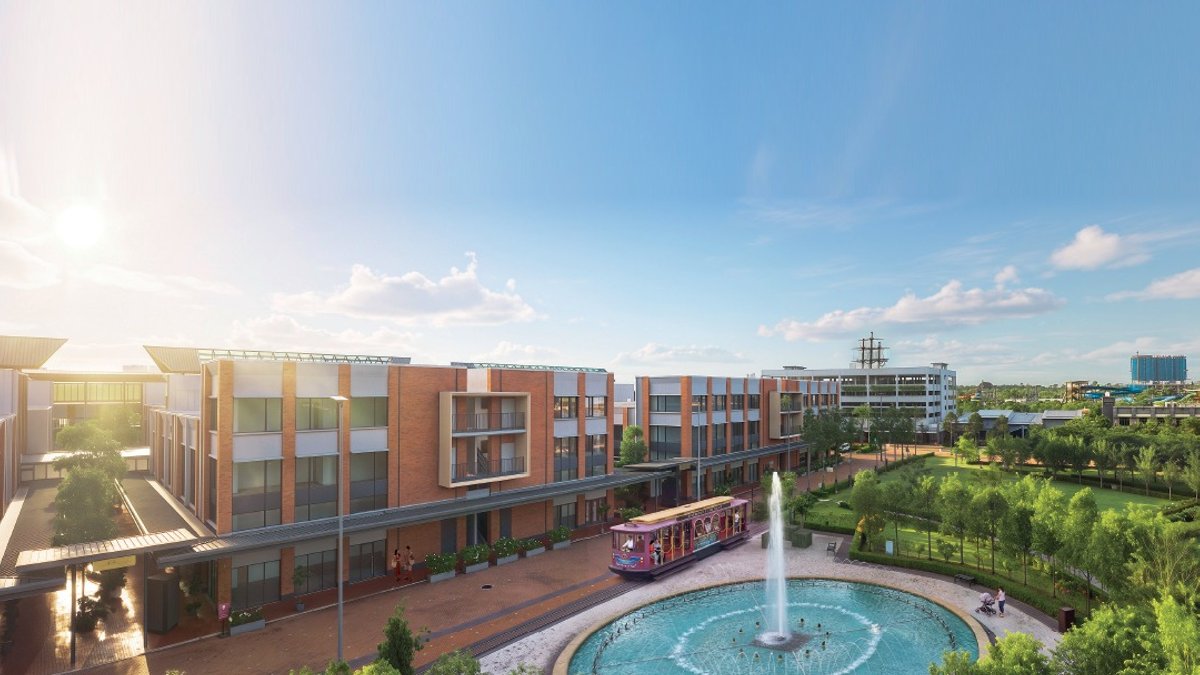
Rehda Youth’s Township Tour Series recently explored Gamuda Cove and the Gamuda IBS Banting Factory, offering insights into modern property development. The tour highlighted how off-site construction and nature-focused planning create sustainable, efficient townships. Organising chair Jane Low emphasized that these locations were chosen to demonstrate the complete lifecycle of modern development, from automated manufacturing to on-site application in a smart city.
Gamuda Cove: A Low-Carbon Smart Township
Located in Selangor, Gamuda Cove is a flagship project by Gamuda Land. It’s Malaysia’s first development to earn a 5-diamond rating under the Low Carbon City 2030 Challenge. The township follows a 15-minute city model, integrating green infrastructure with modern amenities like electric trams and 5G connectivity. An internal carbon audit identified energy (48%) and urban transport (29%) as primary emission drivers, with waste (9%), building components (7%), and water (5%) following.
Gamuda Land’s Leong Sai Pink explained the township’s sustainability framework. By 2030, Gamuda Cove aims to cut carbon emissions by 45%. Key strategies include green building certifications, passive design in residential units, and smart technology in commercial spaces. Commercial assets feature active cooling, smart sensors, solar street lighting, and a minimum solar photovoltaic installation across 30% of roof areas, with a minimum GBI or GreenRE Silver certification.
Gamuda IBS Banting: Transforming Construction
The 66-acre Gamuda IBS Banting Factory showcases digital construction methods. Using 3D Building Information Modeling (BIM), robotic automation, and prefabricated components, the factory has produced over 15,000 units for various projects.
Read Also: Skyro launches online lending in Malaysia
Gamuda IBS senior manager Abang Ibrahim Abdul Rahman emphasized the factory’s role in transforming the workforce. By shifting construction indoors, the factory reduces reliance on foreign labor and improves worker conditions. It also cuts carbon emissions by 41% during production and 53% during construction, driven by precise manufacturing and reduced material wastage.
Architect Axxu Hoi from Axial Design Architects discussed the application of IBS at Gamuda Cove’s Mori Pines project. He noted that IBS speeds up construction by 50% to 60% and ensures better quality control. However, it requires meticulous upfront planning to avoid costly changes later.
Gamuda Cove’s Placemaking Strategy
Gamuda Cove’s COO, Wong Siew Lee, discussed the township’s placemaking strategy. Early placemaking components like SplashMania, the Wetlands, and Discovery Park were designed to kick-start activation and accelerate maturity. These assets operate as separate businesses, expected to self-sustain with minimal cross-subsidization.
Gamuda Cove aims to replicate the performance of Horizon Hills in Johor Bahru, the group’s township of more than 20 years, which generates a 20% to 30% profit margin on launches at this stage of its lifecycle. Future phases of the township’s e-tram will include 11 stops as development progresses.
Read Also: Malaysian SMEs face climate resilience challenges
Gamuda Cove’s Sustainability and Infrastructure
Gamuda Cove also houses the Wetlands Arboretum, a living tree museum of over 200 plant species preserving 3,000 trees. Certified as Malaysia’s first zero-carbon-ready building under EDGE Advanced, it runs on 100% off-grid solar power and uses natural materials like bamboo and rammed earth, cutting embodied carbon by 40%. Gamuda Land conducts biodiversity audits every five years to track ecological recovery, supported by advanced tree planting nurseries and the Miyawaki technique, which accelerates forest growth.
Its interchanges connect it to key areas like KLIA and Cyberjaya, making it a regional destination. The first interchange links directly to the ELITE Highway, while the second, the 2km Bandar Gamuda Cove-Cyberjaya Interchange, provides residents direct access to Cyberjaya.
Asked what she would refine about the township’s masterplan, Wong pointed to the green buffers formed by a mandatory 100m setback from the surrounding wetlands: the 100-acre Wetlands Park and the adjacent Central Park. She suggested staging the delivery of Central Park to better manage capital outflow and aggregate footfall during the township’s early stages.


